OTT Platform: Billing and Subscription Metrics Tutorial
Introduction
This tutorial will guide you through building a time series Forecasting model using Catalyst QuickML to predict future billing and subscription metrics. Using daily historical data from the OTT platform’s billing system, the model aims to forecast trends such as total revenue, new subscriptions, cancellations, upgrades, and coupon usage. We will provide you with a sample dataset that can be used as the data source for the model. Before proceeding with the steps, let’s understand the basics of time series forecasting.
Time series refers to a sequence of data points representing how one or more features change over time. These values are recorded at regular intervals, which allows for the analysis of trends, seasonal patterns, and anomalies within the data. Time series data can be univariate, where only a single feature (such as daily logins) is tracked, or multivariate, where multiple features (such as sessions, screen views, and file uploads) are recorded together over time.
The primary objective of this analysis is to predict future billing and subscription outcomes. This helps businesses make informed decisions about revenue planning, churn management, promotional effectiveness, and capacity forecasting. By identifying temporal dependencies and usage patterns, the model provides actionable insights for optimizing subscription strategies and overall financial performance.
To learn more about time series models, components of time series, and evaluation metrics, refer to the help document.
Now, let’s have a quick overview of the tutorial.
Overview
1. Preprocess the dataset
The dataset contains daily billing and subscription metrics from the OTT platform, including features such as Total Revenue, New Subscriptions, Cancelled Subscriptions, Trial Conversions, Refunds Issued, Upgrades, and Coupon Usage. For this tutorial, we’ll use these multiple variables to build a multivariate forecasting model that captures the interdependencies between different business metrics over time.
In Catalyst QuickML, the first step is to configure preprocessing. The Date column is designated as the timestamp, ensuring that the model correctly interprets the chronological sequence of data points. The dataset is aligned to a daily frequency to maintain consistent time intervals. Because the dataset contains missing values, imputation is applied to fill gaps in the data and preserve temporal continuity. For data normalization, a Square Root–Yeo Johnson transformation is performed to stabilize variance and make the data more normally distributed.
2. Build the time series pipeline
After preprocessing, the pipeline applies the Vector Auto Regressor (VAR) algorithm. VAR is a multivariate time series model that simultaneously forecasts multiple related variables. Unlike uni-variate models, VAR captures the influence of each metric on the others; for instance, how new subscriptions and cancellations jointly affect total revenue trends.The pipeline runs from the source dataset, through preprocessing, into the VAR algorithm, and finally outputs the results to the destination component.
3. Deploy the model via endpoint
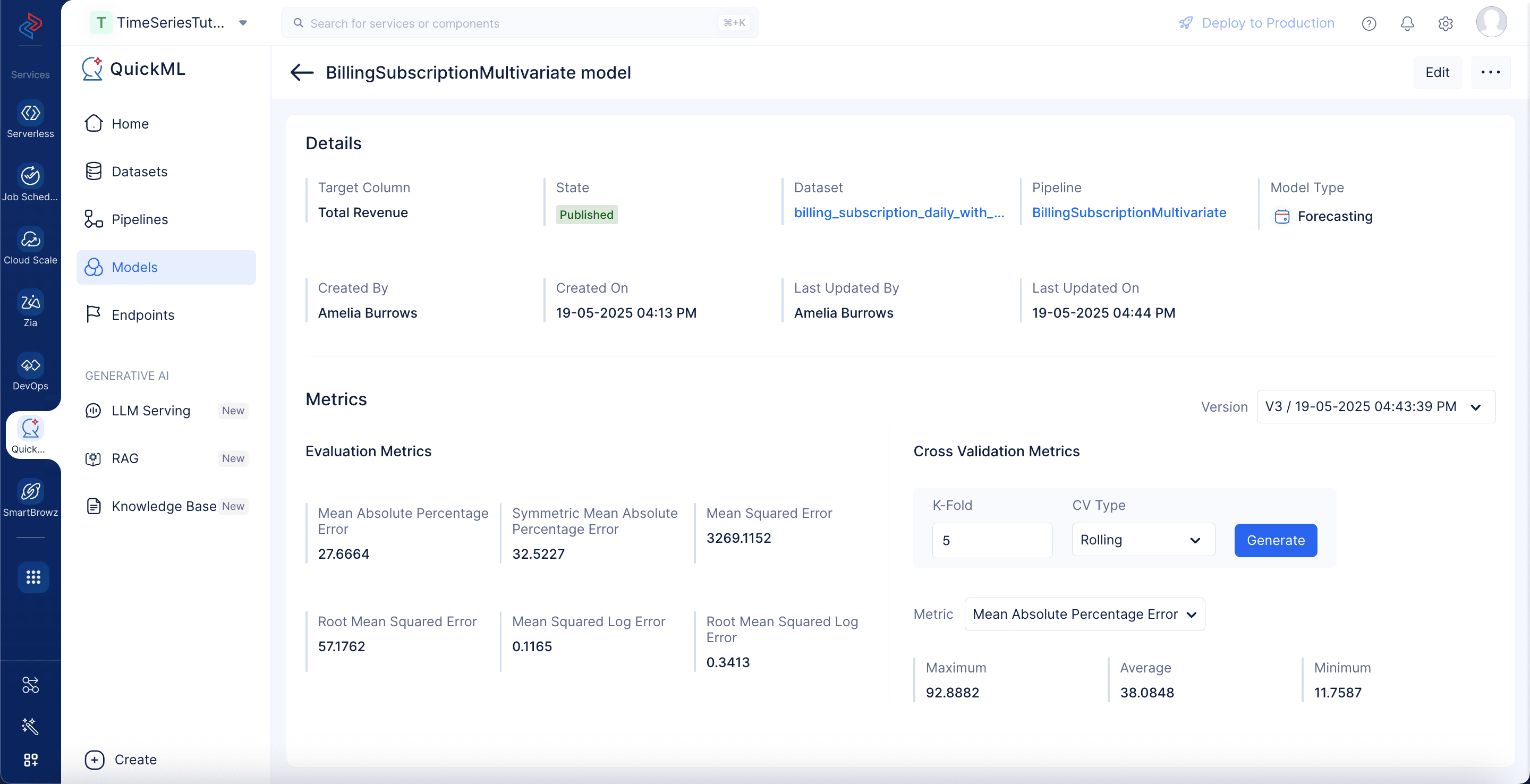
After training, the model can be deployed directly from the Catalyst console by generating an endpoint URL. This endpoint allows external applications or dashboards to send recent billing data and receive real-time forecasts for future revenue and subscription metrics. Along with the predictions, the model also outputs evaluation metrics such as MAPE, RMSE, MSE, MSLE, RMSLE, and SMAPE, which help assess its accuracy. Also, the model uses cross validation metrics to test its robustness over time, and mean percentage error to ensure that the model’s forecasting performance remains consistent across different time windows.
The final output comprises the forecasted daily values for key billing and subscription metrics, along with validation scores that measure model performance. These forecasts help in revenue planning, churn analysis, and promotional strategy optimization.
Last Updated 2026-09-29 11:31:01 +0530 IST