Cancer Detection
Introduction
In this tutorial, we will guide you through the process of building a machine learning (ML) model for breast cancer detection using Catalyst QuickML. The goal is to preprocess medical datasets, construct data and ML pipelines, train the model, and deploy it for real-time predictions. Here’s how we’ll go about it:
Stage 1: Preprocessing the Dataset
Before training any machine learning model, it’s essential to clean and preprocess the datasets to ensure it’s in a usable format. This helps to ensure the data is clean and aligned with the requirements of machine learning algorithms.
Stage 2: Constructing the Data Pipeline
Once the data is preprocessed, we need to design a data pipeline to handle any necessary data transformations before feeding the data into the machine learning model.
Stage 3: Building the Machine Learning Model
With the preprocessed data ready, we will then focus on constructing the machine learning (ML) pipeline to train the cancer detection model. Catalyst QuickML simplifies the training process by providing an easy-to-use platform to apply different machine learning algorithms. We will choose a suitable algorithm, train the model on the prepared data, and evaluate its performance to ensure it can accurately predict breast cancer outcomes.
Stage 4: Deploying the Model for Real-Time Predictions
Once the model is trained and evaluated, we need to make it available for real-time predictions. Catalyst QuickML deploys the trained model by generating an endpoint URL. This endpoint enables external applications to interact with the model and request real-time predictions based on new data. By creating and exposing this API, we allow other systems or users to submit medical data and receive predictions from the model in real time.
The Cancer Detection ML model is built using the following Catalyst service:
Catalyst QuickML: Using this service, we will first preprocess the sample dataset by implementing node operations on them and constructing the data pipeline. This preprocessed data will be used to a create ML model by executing ML algorithms. Finally, the Cancer Detection ML model can be accessed by external applications using the endpoint URL generated in QuickML.
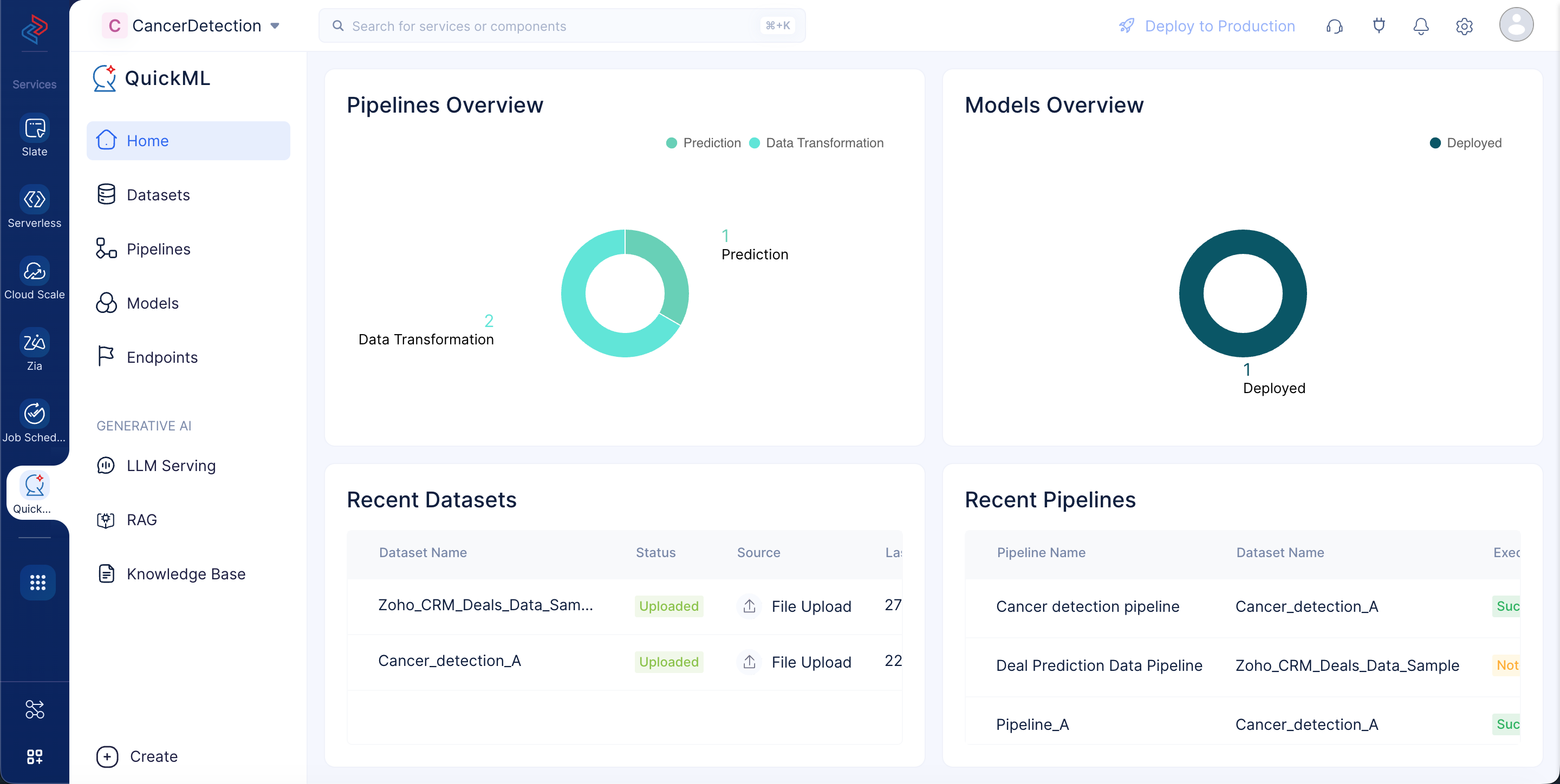
The final output after creating all of the required data and ML pipelines in the Catalyst console will look like this:
Last Updated 2026-10-01 12:33:46 +0530 IST